Pronounced “Kam-iss”, this manor is found in the village of the same name. Cambois is a small sea-port between the rivers Blyth and Wansbeck in the parish of Beddington. It is thought that the name is a corruption of ‘Cambhouse” from cambium, or a trading or bartering house or perhaps derives from the Gaelic word cambas meaning a bend in the river. There are similarly named ports in Scotland and France.
The main village sits upon a knoll above the Wansbeck and in the 19th century became a center of coal.
Like many manors in Northumberland the early history of Cambois is rather obscure. Northumberland does not appear in Domesday book of 1086 but clearly it was an ancient settlement. In 1859 a burial mound was excavated and a brooch and comb, dating from around 850, were discovered. At the end of the 9th Century it is recorded that Bishop Cutheard of Lindisfarne bought, no doubt from the Danes, the township of Bedlington with its dependencies of Netherton, Grubba(Gubeon) Twisle , Cebbingtun (Choppington) Sliceburne (Sleekburn) and Commes (Cambois) (1) This appears to be the easiest reference to the village.
The manor itself is not mentioned until 1285 when Margery de Gosebeck was found to be the owner of Cambois at the time of her death. At the beginning of the 14th century there seemed to be a number of Lords in quick succession. In 1317 William Hasilrig was confirmed by Edward II in a grant made to him by the bishop of Durham, who was likely the Overlord.
In 1326 Edward granted four tofts and 80 acres of land here, to William de Denum and a further grant of one sixth of the manor from the Bishop Beaumont. Denum was temporal chancellor to the Beaumont, a secular position to bishops in the Palatinate. Over the next few years Denum accrued much of the rest of the manorial land here as his career progressed. He was considered to be one of the most eminent lawyers in the North East of England. As well as his role as temporal chancellor to the bishops of Durham he sat as Lord Chief Justice of Berwick. His main residence was in Cambois and on his death in 1350 his estate, which included the manor of Cambowes and Slikeburne, passed to his wife, Isabella. She is recorded as giving 24 marks to the Crown for both manors in 1359.
After Isabella’s death on 1359 the descent of Cambois become slightly confused due to a paucity of historical records. It is thought that Cambois passed to her daughter, Isabella de Rigges but its history after this is uncertain until the early years of the 15th century when it had passed into the hands of Ralph Neville, Earl of Westmoreland. Born in 1364, Neville was the son of John, 3rd Baron Neville and Maud Percy, the daughter of Baron Percy of Alnwick, and one of the most famous Northern families. In his youth Ralph has a successful military career, fighting in France and then being appointed joint Governor of Carlisle, with his kinsman, Sir Thomas Clifford. Though he supported Richard II (who has made him Earl of Westmorland) his marriage to Joan Beaufort in 1396 made him the son in law of John of Gaunt, 1st Duke of Lancaster.
When Richard banished Gaunt’s eldest son, Henry Bolingbroke in 1399, Neville supported his brother-in law and was part of the deputation at the Tower Of London which received the abdication of Richard II. On Henry’s accession to the throne, Wetsmorland was made Earl Marshall and Warden of the West March, he fought a sustained rebellion by the Percy family until their defeat in 1405 when he received a large grant of their former lands. It is possible that Cambois formed part of this grant. On his death in 1426 it was found that Westmorland held the manor of Cambouse, with its appurtenances in Bedlingtonshire, besides a messuage in Nedderton, half the manor of West Sleekburn, and the manor of Choppington. At the time it was noted that at the time of Neville’s death the tenant of Cambios, at that time paid for it, to the bishop, a rent of £4 19s. a year, and did suit at the lord’s court at Bedlington, ground his corn growing upon the manor at the lord’s mill, to the sixteenth measure -had within it the site of a manor then waste, and of no value; but that there were there four messuages and six bovates of arable land, worth beyond reprizes 40s.; twenty acres of meadow, worth 20s.; and 100 acres of pasture, worth 16s. 4d.
The Manor of Cambois remained in the hands of the succeeding Earls of Westmorland until the late 1540s when it was sold by Henry, the 5th Earl to a merchant named Lawson. In 1626 Henry Lawson and his wife Ann, sold the manor to Andrew Young. Little is recorded of Andrew Young nor of how the manor subsequently passed to the Ridley family, in whose possession it remained until the late 20th Century. Dame Mary Younge is recorded in a legal case against Elizabeth Cramlington over property in Cambois in 1661 and thirty years later Joseph Younge was in dispute with William Urwen, perhaps over the same property.
By the middle of the 18th century the manor was sold or perhaps passed through marriage, to the Ridley family. John Wallis’ history of Northumberland notes that Matthew Ridley was the owner in 1769. The Ridley’s had been part of the landed gentry of the county since the 15th century and had a number agricultural and industrial interests, primary in coal mining. Born in 1711, Matthew Ridley was twice elected Member of Parliament for Newcastle and was Mayor of the city the city three times. The last member of the family to hold the manor was Matthew, 4th Viscount Ridley, who sold the title in 1986 to Anne Marie Cartier.
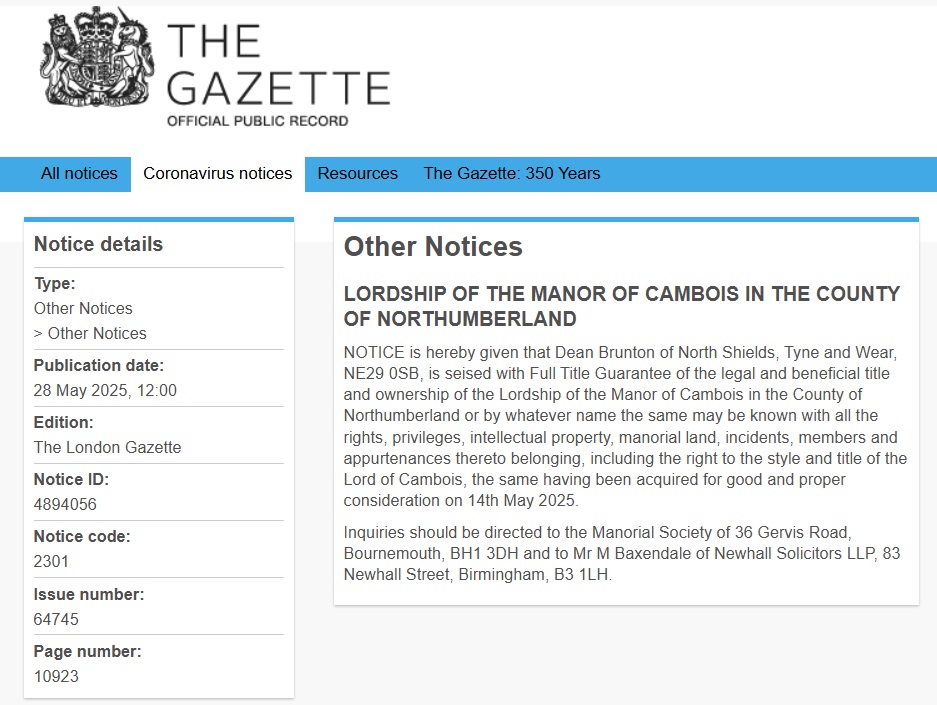
Anne Marie Cartier sadly passed away 17th April 2017 and the Manor was held in probate awaiting a grant of Letters of Administration. This was granted in April 2025, allowing the late Anne Marie Cartier’s representative to transfer the Manor to Dean Brunton (2). The Manor was then transferred to Dean Brunton on the 14 May 2025.
Dean Brunton is the current holder of the Lordship of Cambois.
Selection of Manorial Records Held in the Public Domain
1413-1414: rental
1591-1720: court books (97)
1600-1600: survey
1631-1794: rentals (32 bundles)
1700-1766: rentals (36)
1707-1809: call books (8)
1715-1784: presentments (18 bundles)
1721-1925: court books (6)
1804-1857: rentals (28)
1809-1891: call books (2)
1882-1882: rental
Durham University Library and Collections
- History of Northumberland – Cadwallader John Bates 1895 p93
- The Gazette (London Gazette) – Notice ID 4894056