Feudalism was the backbone of medieval European society, shaping politics, warfare, and daily life for centuries. It was a system built on landownership, loyalty, and hierarchy, emerging in the power vacuum left by the fall of the Western Roman Empire. Though feudalism declined by the early modern period, its influence lingers—many noble titles and traditions established during the Middle Ages remain in use today.
Origins: The Birth of Feudalism
Feudalism developed as a response to the instability following the fall of Rome in the 5th century. Without a centralized government, local lords filled the power void, offering protection to peasants and warriors in exchange for land-based service. The system took root among the Franks, particularly under Charlemagne (r. 768–814), who granted land (fiefs) to loyal vassals in return for military support.
Feudal structures also existed in earlier civilizations, such as ancient China during the Zhou Dynasty (1046–256 BCE), but medieval Europe’s version would shape history in a unique way.
The Structure of the Feudal System
The feudal system was built on land in exchange for service, creating a rigid social hierarchy, consisting of several key levels:
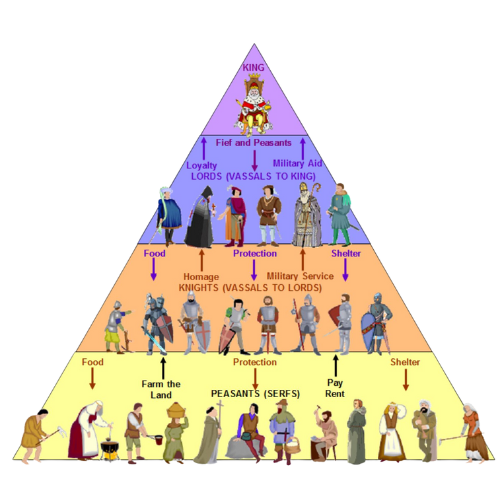
- The King – At the top of the feudal hierarchy, the king owned all land and granted large portions to powerful nobles in exchange for military support.
- Nobles and Lords – Dukes, barons, and other high-ranking nobles managed vast estates and pledged allegiance to the king. They distributed smaller portions of land to knights and vassals.
- Knights and Vassals – Knights served as the military force of the feudal system, providing protection to their Lords in return for land and privileges.
- Peasants and Serfs – The backbone of medieval society, peasants worked the land and produced food. Serfs, who were tied to their Lords’ estates, had little personal freedom but were granted security and a place to live.
Power was decentralized, meaning local lords held more authority than the king in many regions. Manorialism, an economic system tied to feudalism, made estates self-sufficient, with peasants working the land to produce everything necessary for survival.
The Manor System: The Heart of Feudal Life
The economic foundation of feudalism was the manorial system. Each manor functioned as a self-sufficient unit, with peasants farming the land and producing essential goods. Lords governed these manors, ensuring the community’s safety and overseeing economic activity. The manor system allowed feudal society to thrive by maintaining agricultural production and resource distribution.
Feudalism Beyond Europe
While feudalism is most associated with medieval Europe, similar systems appeared elsewhere:
- Japan (12th–19th centuries): The shogunate mirrored European feudalism, with a shogun as the de facto ruler, daimyo as landowning lords, and samurai as the warrior class.
- Russia: The boyar system functioned similarly, with aristocratic landowners controlling vast territories until serfdom was abolished in 1861.
- The Mughal and Ottoman Empires: These Islamic empires operated with feudal-like land grants, where military leaders were given land in exchange for service.

The Decline of Feudalism
By the late Middle Ages, several factors led to the decline of feudalism:
- The Growth of Towns and Trade – The rise of commerce created new economic opportunities, weakening the land-based structure of feudal society.
- The Black Death (1347–1351) – This devastating plague reduced Europe’s population, leading to labor shortages that empowered peasants to demand better wages and rights.
- The Rise of Centralized Monarchies – Kings consolidated power, reducing the influence of feudal lords.
- The Shift to a Money-Based Economy – The increasing use of currency diminished the reliance on land ownership for wealth and power.
By the 16th century, feudalism had faded across much of Western Europe, replaced by nation-states and centralized monarchies. However, its impact on social structures remains visible today.
The Lasting Legacy of Feudalism
Though the feudal system itself disappeared centuries ago, its impact is still visible today. Many monarchies and noble titles originated in the feudal era, and remnants of feudal law still influence modern property rights, aristocratic traditions, and governance structures.
For history enthusiasts, feudalism offers a glimpse into an era of castles, knights, and political intrigue. Whether in medieval ruins, heraldic symbols, or noble family names, the echoes of feudalism continue to shape the world today.